When Supplier Surveys Don’t Answer the PFAS Question

For many manufacturers, PFAS risk management starts with the Safety Data Sheet. If SDS Section 3 does not list PTFE, PVDF, fluoroelastomers, fluorosurfactants, or other PFAS-related substances, the material may appear to be low risk.
But as discussed in the first blog in this series, SDS documents are necessary but not sufficient. PFAS can be hidden outside Section 3, especially when present as a low-level additive, processing aid, coating, surface treatment, or upstream formulation ingredient.
So companies take the next logical step: they ask the suppliers.
The supplier survey is useful but the workflow around it has limitations.
Supplier engagement is essential for PFAS compliance, customer response, material risk management, and product stewardship. But in real-world manufacturing supply chains, supplier surveys often produce answers that are incomplete, inconsistent, delayed, or difficult to defend.
The issue is not simply that suppliers are unwilling to respond. The deeper problem is that traditional supplier surveys are being asked to solve a PFAS intelligence problem they were not designed to solve. Most compliance teams know how to send supplier questionnaires: upload a supplier list, attach a template, request PFAS declarations, send reminders, and track responses. That process can help collect documents. But PFAS risk management requires more than document collection.
A useful PFAS declaration needs to answer several questions. Does the product contain intentionally added PFAS? Could PFAS be present through upstream raw materials, coatings, additives, processing aids, lubricants, membranes, or contamination? Which PFAS chemistry or class is involved? What is the likely concentration? Is the answer based on formulation knowledge, testing, supplier certification, or SDS review?
Those questions are difficult to answer with a generic yes/no survey, especially when the supplier is several tiers away from the original chemical formulator.
“No PFAS” often means “no known PFAS”.
One of the most common supplier responses is some version of: “To the best of our knowledge, this product does not contain PFAS.” That answer may be honest. It may also be insufficient.
“No PFAS intentionally added by us” is not the same as “no PFAS present.” “No PFAS listed on the SDS” is not the same as “PFAS-free.” “No known PFAS” is not the same as a defensible PFAS declaration.
This creates a dangerous gray zone. A response may look complete in the survey tracker, while the evidence behind it remains weak.
Suppliers interpret PFAS differently.
PFAS is not a single chemical. It is a broad and evolving chemical family, and definitions vary across regulations, customer requirements, and internal policies.
One supplier may answer “no PFAS” while thinking only about PFOA, PFOS, or a short list of restricted substances. Another may include fluoropolymers such as PTFE, PVDF, FEP, PFA, ETFE, or fluoroelastomers. A third may exclude polymers entirely. A fourth may focus only on intentionally added PFAS, while the customer is trying to understand broader product risk.
The result is false consistency. A spreadsheet may show hundreds of “No” responses, but those responses may be based on different definitions, thresholds, assumptions, and levels of knowledge.
Supplier responses are rarely evidence-graded.
In many systems, a supplier response is treated as complete or incomplete. But for PFAS, the quality of the answer matters as much as the answer itself.
A “No PFAS” response based on a full formulation review is very different from one based only on SDS Section 3 or general sales knowledge. A “Yes” response that includes a CAS number and concentration range is very different from one that says only “contains fluorinated chemistry.”
Without evidence grading, teams may over-trust weak negative declarations and underuse valuable partial disclosures.
Response rate is not the same as risk reduction.
Supplier survey programs often measure progress by response rate. But a 90% response rate can still leave the business exposed if the remaining 10% includes high-risk materials, critical components, high-volume purchases, or products tied to customer reporting obligations.
In PFAS risk management, non-response is not neutral. It is a risk signal.
From supplier survey to supplier intelligence
Supplier surveys are still necessary, but they should not be the only intelligence layer.
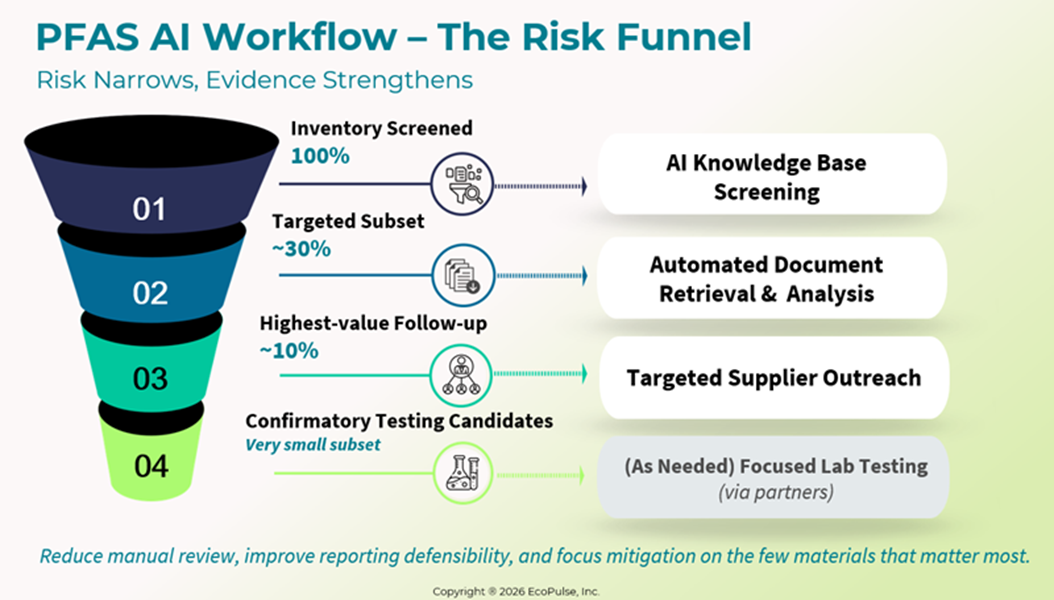
A stronger workflow starts before the survey is sent. It identifies which materials and product categories are more likely to involve PFAS, what evidence already exists, which suppliers should be prioritized, what specific questions should be asked, and how much confidence should be assigned to each response.
This is where EcoPulse helps manufacturers move beyond generic supplier outreach.
EcoPulse treats supplier declarations as one evidence stream within a broader PFAS risk intelligence process. It helps teams complete efficient and consistent inventory screening and risk review internally first to identify products that require more attention and follow-up, and then generate more targeted supplier questions and supplier list. After the supplier declaration is collected, it continues to compare supplier claims against product context and external evidence, assign confidence levels, and prioritize unresolved risks.
The goal is not simply to collect more declarations. The goal is to give manufacturers the intelligence, control, and visibility needed to proactively build a defensible PFAS risk picture.
Supplier surveys are essential, but they are not enough on their own. The next stage of PFAS risk management is leveraging comprehensive and automated risk review to enable smart and targeted outreach: moving from generic surveys to risk-informed supplier intelligence.