The PFAS Risk Hiding Beyond SDS Section 3

For many manufacturers, the PFAS review process starts with a familiar document: the Safety Data Sheet. The SDS is accessible, standardized, and already embedded in EHS and procurement workflows. So when Section 3 does not list PTFE, PVDF, fluoroelastomers, fluorosurfactants, or other PFAS-related substances, it is tempting to mark the product as “PFAS not identified” and move on.
That can create false confidence.
PFAS risk is not always visible in SDS Section 3. In fact, some of the most important PFAS signals may sit outside the SDS altogether: in product specifications, technical data sheets, industry literature, supplier formulations, regulatory lists, and comparable product evidence.
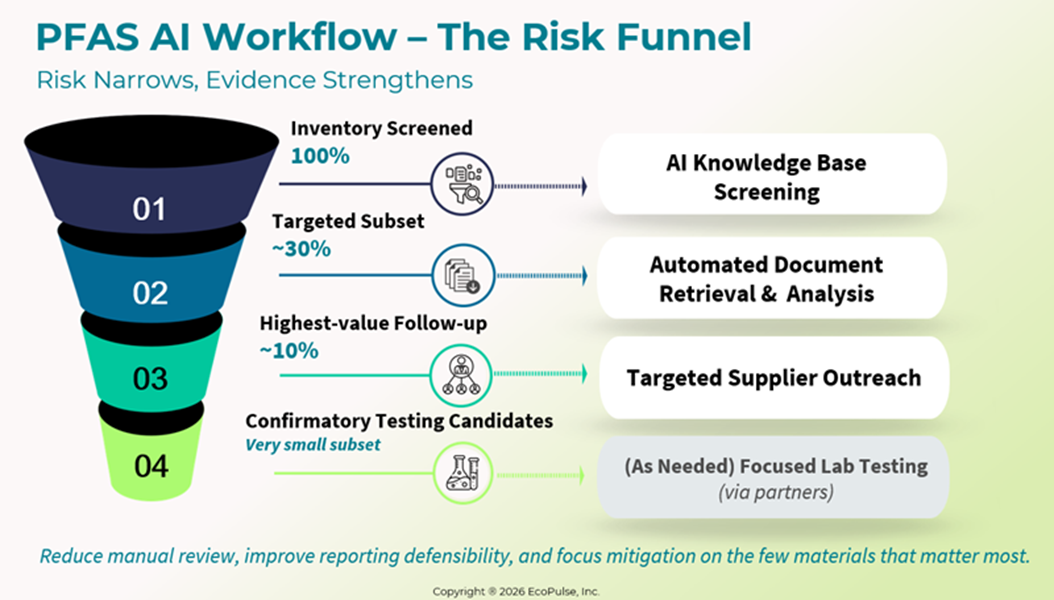
This is exactly where PFAS AI changes the workflow. Instead of treating the SDS as the final answer or main evidence, PFAS AI treats it as one evidence source in a broader risk-intelligence process.
The SDS was not designed to be a complete PFAS disclosure document
We know that SDS Section 3 is primarily a very effective hazard communication tool. Under OSHA’s SDS requirements, mixture composition disclosure focuses on ingredients classified as health hazards above applicable cutoffs, or ingredients that present a health risk below those cutoffs. SDS rules also allow certain chemical identities or concentrations to be withheld as trade secrets when the required statement is provided.
That means “not listed in Section 3” does not always mean “not present.”
Example: when Section 3 is silent, but the product still deserves a PFAS flag
Consider an anonymized example:
Product: LLDPE blown-film resin or polyolefin film grade
SDS Section 3: Lists polyethylene/resin components and generic additives; no PFAS chemical, no PTFE, no PVDF, no fluoroelastomer, no fluoropolymer CAS number.
Manual SDS-only conclusion: “No PFAS identified.”
PFAS AI conclusion: “Medium to Highlikelihood of fluoropolymer processing aid; estimated concentration range: approximately 80–500 ppm, or 0.008–0.05 wt%, subject to supplier confirmation.”
Why would PFAS AI flag this?
Because the SDS is only one signal. PFAS AI would evaluate product type, use case, manufacturing context, comparable products, and research evidence. Public technical references show that fluoropolymer-based polymer processing aids are commonly used in linear polyolefin extrusion to reduce melt fracture, sharkskin defects, die pressure, and surface imperfections. A 2014 paper on LLDPE extrusion describes fluoropolymer-based polymer processing aids as commonly used in industry to suppress surface defects and reduce die pressure.
The broader PFAS use literature also recognizes fluoropolymers such as PTFE as processing aids and raw materials in plastics and rubber production. Product and patent literature further shows examples of fluoropolymer processing-aid systems using VF2/HFP fluoro elastomers, FEP, and related fluoropolymer chemistries at low ppm levels. In one example, a processing aid system introduced at 400 ppm resulted in 80 ppm fluoropolymer processing aid; another system introduced at 400 ppm resulted in 120 ppm fluoropolymer processing aid. Commercial product literature also describes fluoropolymer-based polymer processing aids used at low addition levels such as100–500 ppm.
The AI-generated insight also clarifies the reasoning and evidence behind its conclusion:
Although SDS Section 3 does not disclose a PFAS chemical, the product category and supporting technical literature indicate medium to high likelihood of fluoropolymer processing-aid use. Likely PFAS class: fluoropolymer processing aid, potentially PVDF/VDF-HFP fluoroelastomer or related fluoropolymer chemistry. Estimated concentration: 80–500 ppm, based on comparable processing-aid literature and product-use patterns. Recommended action: targeted supplier confirmation and, if business-critical, focused testing.
That is a much stronger compliance workflow than a simple SDS keyword search.
The takeaway
SDS documents are necessary, but they are not sufficient.
A clean SDS Section 3 can be useful evidence, but it should not be treated as proof of PFAS absence. PFAS risk often lives in the spaces between documents: product function, material family, supplier history, industrial use patterns, technical literature, and low-level additives.
PFAS AI helps manufacturers close that gap. It finds the signals SDS review misses, estimates likely PFAS chemicals and concentration ranges when evidence supports it, and creates a more defensible workflow for supplier outreach, reporting readiness, and risk mitigation.