AI-Led Risk Funneling Can be the Future of PFAS and Chemical Risk Intelligence
The first two posts in this series identified the same problem from two different angles. The first showed that a clean SDS Section 3 is not proof of PFAS absence — the real signal often sits in product function, material family, and technical literature that no keyword search will surface. The second showed that supplier surveys, while necessary, tend to produce answers that are inconsistently defined, rarely graded by the strength of the evidence behind them, and require lots of effort from both sides. Also a “No PFAS” response, we noted, often means “no known PFAS.”
Put side by side, they are the same problem within this process, manufacturers are trying to resolve a chemical risk question with a fragmented, one-off process, and fragmented processes do not scale to the size of a real global product and supplier portfolio.
The problem with traditional PFAS review: it starts too narrow
Traditional PFAS review often starts with the documents that are easiest to access. A team collects SDS files. They search for familiar terms such as PTFE, PVDF, PFOS, PFOA, fluoropolymer, fluoroelastomer, fluorosurfactant, and perhaps a couple more, or they run CAS number against certain PFAS regulatory lists. They also send supplier questionnaires. They track responses in spreadsheets and follow up with non-responders.
This workflow can produce activity, but it does not always produce risk clarity.
The highest-risk materials are not always the ones with obvious PFAS terms in the SDS. A supplier “no PFAS” response may be based only on the supplier’s own knowledge, not on upstream formulation data. A product may contain low-level fluorinated processing aids, coatings, lubricants, membranes, seals, films, or surface treatments that do not appear in the expected places. A critical component may carry more business risk than a higher-volume material because of customer exposure, regulatory obligations, or lack of substitutes. The current workflow often starts with isolated and limited evidence and tries to build a risk picture from there.
PFAS risk review works better when the process is reversed. Instead of asking, “Which document mentions PFAS?” manufacturers should ask, “Which materials are most likely to create PFAS exposure based on solid screening, and then what prioritized and targeted actions do we need to take to confirm, reduce, or resolve that risk?”
That is the logic behind the EcoPulse risk funnel, especially for global manufacturers who routinely carry thousands to hundreds of thousands of SKUs, formulations, and supplier relationships.
EcoPulse AI-led risk funneling: screen broadly, focus intelligently, and act with confidence
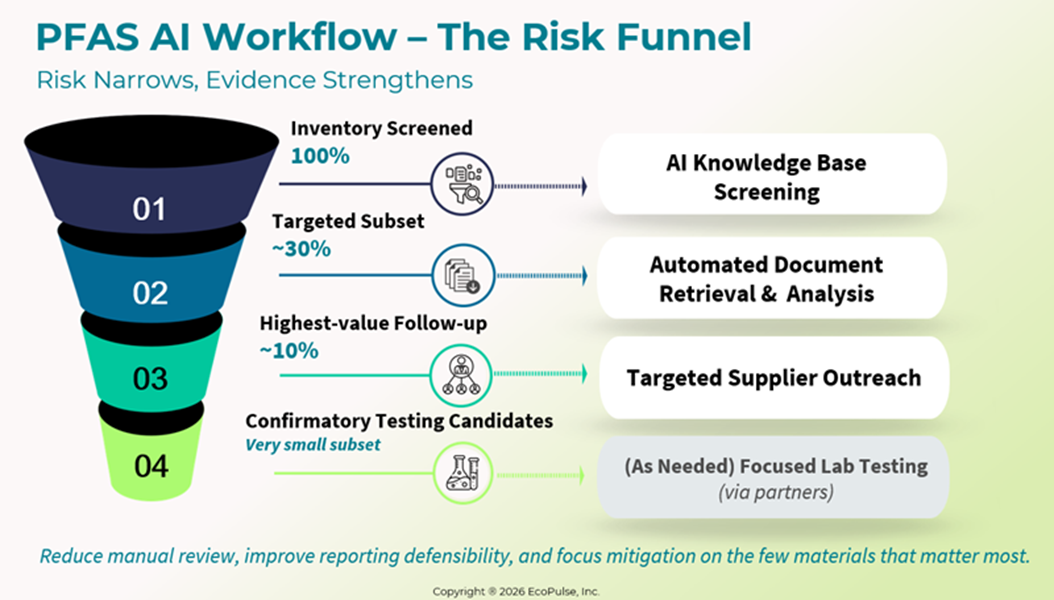
EcoPulse’s AI-led risk funneling approach is designed to help manufacturers move from fragmented document review to structured chemical risk intelligence.
The core idea is simple:
Screen everything.
Narrow the focus.
Strengthen the evidence.
Act where risk is highest.
Full-inventory ingestion — every product, material, and supplier record is analyzed together as a single portfolio, not queued and reviewed one at a time.
Consistent evidence-based triage — PFAS AI screens each item against its knowledge base, web-retrieved product documents (SDS,TDS, product specs), technical-literature pattern matching and more with high accuracy and efficiency. Items with strong, consistent low-risk evidence clear the funnel immediately; everything else moves forward carrying an assigned risk tier and confidence level.
Confidence-graded resolution — for high risk or selected items, the system can generate specific, chemistry-informed supplier questions instead of a generic PFAS questionnaire or integrate with partner’s supply chain engagement platform, then assesses supplier responses against existing product information and AI insights rather than accepting a "No" at face value.
Prioritized action queue — what comes out the bottom of the funnel is not a longer list of open questions. It is a ranked, evidence-backed shortlist of the specific materials, products, and suppliers that need lab testing, reformulation review, or even legal escalation. The output is provided with the reasoning behind every entry preserved for audit and customer disclosure.
Each stage narrows the population and raises the confidence of what is left, so scarce compliance time concentrates on the fraction of the portfolio where real risk lives. The risk funneling reduces noise while increasing confidence
Beyond PFAS: the same funnel, the next chemical of concern
The specific chemistry will change. PFAS is the most urgent case today, but phthalates, select flame retardants, and the next additions to the EU’s Substances of Very High Concern list will raise the identical failure mode tomorrow: incomplete documentation, inconsistent supplier answers, and portfolios too large to review by hand. An AI-led risk funnel built to weigh fragmented evidence and grade declarations is not a PFAS point solution, it should be a reusable architecture for whatever chemical risk question a global manufacturer faces next. That is the broader bet behind EcoPulse’s approach: build the risk funnel and workflow, and let it carry the compliance function from PFAS into the next chemical of concern.
The takeaway
EcoPulse built this AI-led risk funnel to provide manufacturer or industry company an efficient, prioritized, evidence-backed path to action, which is defendable to regulators, customers, and their own leadership.