The True Cost of PFAS: Why Proactive Screening Is the Smartest Financial Strategy for 2026 and Beyond
PFAS Remediation Costs Are Exploding — And Delayed Action Multiplies Liability
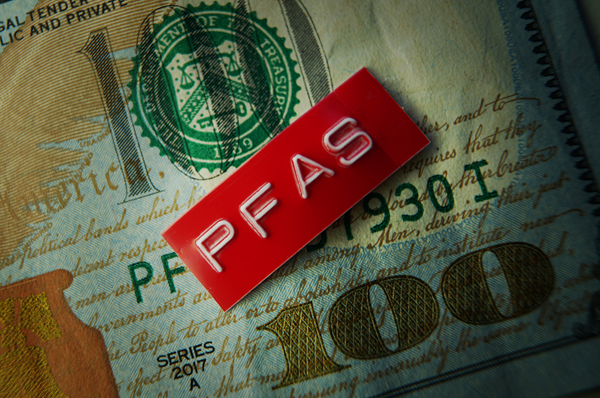
PFAS pollution is increasingly recognized as both an environmental and economic issue, with growing financial implications for businesses and public systems. A January 2026 European Commission summary of a commissioned study estimates that continuing current PFAS pollution levels through 2050 could cost approximately €440B, and notes that treating contaminated water alone could exceed €1T. The report also emphasizes that because PFAS persist for decades in the environment and in the human body, earlier action can reduce long-term health and remediation costs.
A similar conclusion appears in an analysis from NYU School of Law’s Institute for Policy Integrity, which argues that PFAS-related damages are substantial and likely underestimated due to limited coverage of PFAS chemicals and incomplete exposure pathways in many economic models. The report also highlights the extreme cost of remediation, estimating that the cost per kilogram of PFAS removed can range from $ 0.9M to $60M.
Taken together, these findings reinforce that PFAS is no longer only a regulatory reporting topic. As global restrictions expand, PFAS exposure increasingly represents a material financial and operational risk, with rising compliance pressure and long-term liability implications.
The Economic Shift: Prevention and Data Transparency Are Now Cheaper Than Cleanup
As remediation costs rise into the billions, the economics of PFAS management shift significantly. End-of-pipe treatment alone is no longer sufficient. Regulators and economists increasingly emphasize upstream exposure reduction, including stronger controls, use restrictions, improved data transparency, and material substitution, as a more economically sound approach.
For companies, this means PFAS compliance has become a supply chain data challenge at scale. Many organizations still rely on manual Safety Data Sheet reviews, supplier surveys, consultants, and selective laboratory testing. While these methods provide value, they are often slow, fragmented, and resource-intensive. A thorough manual review can take approximately one hour per material. For companies managing thousands or even hundreds of thousands of materials, this approach is difficult to scale within regulatory timelines.
The longer potential PFAS exposure remains unidentified, the greater the downstream risks, including remediation costs, regulatory penalties, product reformulation, reputational impact, and supply chain disruption. In this context, proactive screening supports more financially responsible and strategic risk management.
The ROI of AI-Driven PFAS Screening: Speed, Scale, and Smarter Decisions
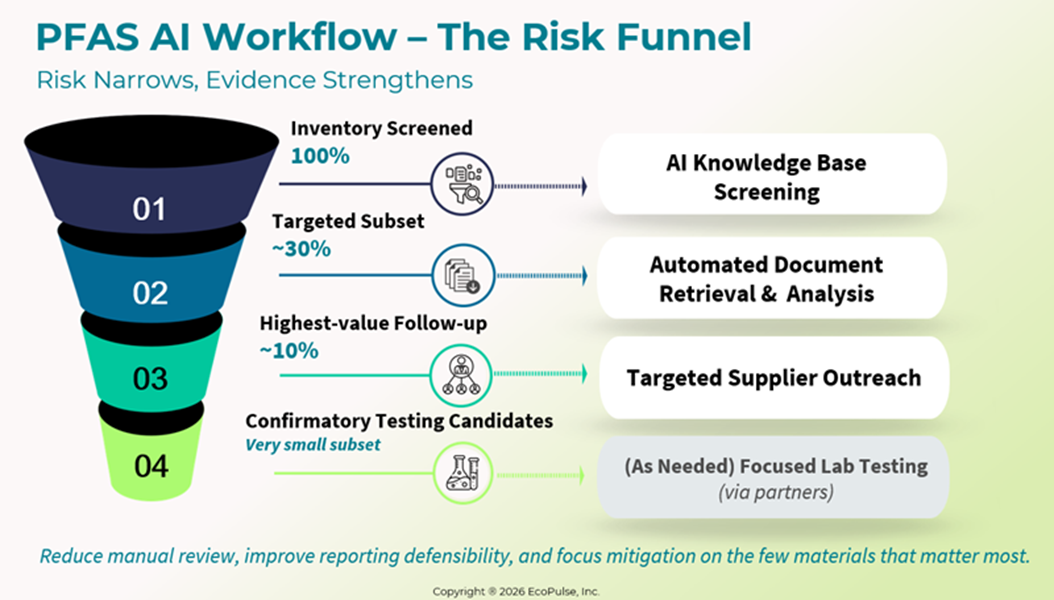
AI-driven PFAS screening provides a scalable method for identifying potential PFAS risks early in the supply chain, before they evolve into costly remediation or complex regulatory exposure.
From a resource perspective, manual PFAS review can take approximately one hour per material, making large portfolios difficult to assess comprehensively. AI-based screening can analyze hundreds of materials within minutes, allowing organizations to evaluate broader product scopes in a realistic timeframe.
Beyond speed, advanced PFAS AI tools analyze more than just SDS Section 3 disclosures. They review Safety Data Sheets, product specifications, manufacturer information, relevant research literature, and structured PFAS knowledge bases to assess potential PFAS presence with greater contextual understanding.
This broader analysis supports more informed decision-making. Instead of relying solely on binary compliance checks, companies can identify areas of higher PFAS risk across suppliers and product categories, prioritize follow-ups, and strengthen documentation. In a regulatory landscape where remediation costs can be extremely high, early risk visibility supports more responsible and economically sound management strategies.
About EcoPulse
EcoPulse is an Austin, TX–based AI company helping manufacturers identify, document, and reduce PFAS risk across products and supply chains.
The patent-pending PFAS AI platform supports EHS and Product Compliance teams with specialized AI models and a deep knowledge base for PFAS risk assessment, reporting and mitigation. EcoPulse is advancing PFAS and Product Safety intelligence and risk mitigation for manufacturers and supply chains.