PFAS in the Bigger Picture — Webinar Takeaways
PFAS is often discussed as a compliance topic, but one of the clearest takeaways from our recent webinar was that it is now a much broader business risk. It also reflects how modern risk increasingly appears inside organizations: spread across functions, buried in fragmented data, and difficult to interpret quickly. In the webinar, EcoPulse CEO Jenny Yu and guest speaker, Chet Brandon, Sr. Director of Global EHS at Hexion, discussed what is still missing in today’s EHS and supply chain risk intelligence, where AI can add real value, and why the bigger opportunity is not just faster analysis, but better, more proactive risk decisions, with EcoPulse PFAS AI solution as a practical use case and example.
Key Takeaway 1: PFAS is not a siloed problem
PFAS risk is no longer confined to one team or one reporting requirement. It affects multiple parts of the business at the same time:
- EHS and sustainability teams face exposure, environmental, and compliance concerns.
- Engineering and R&D teams face redesign pressure, material restrictions, and alternatives evaluation.
- Procurement and supply chain teams face supplier disruption, limited transparency, and heavy manual follow-up.
- Legal and leadership face liability, reputational risk, and potential bottom-line impact.
- Operations and commercial teams can also be affected through facility issues, customer demands, and threatened deals.
Key Takeaway 2: Today’s risk intelligence is still too fragmented
One of the clearest messages from the webinar was that companies are not lacking data — they are lacking connected, usable intelligence.
- Important information is spread across too many systems, documents, and workflows.
- Most tools tell teams what already happened, not what is building.
- Context is often the missing piece.
- Human teams spend too much time collecting and reconciling information before they can act.
That fragmentation makes it harder to identify emerging risk early and respond in a focused way.
Key Takeaway 3: AI’s role is augmentation, not replacement
The webinar emphasized a practical executive view of AI in EHS and supply chain:
- AI is strongest at pattern recognition at scale.
- AI can improve the speed and quality of decisions.
- AI should support experienced leaders, not replace them.
In other words: Think beyond chatbots; Use AI to analyze large volumes of information and surface trends humans may miss; Keep human oversight in place for ethics, risk tolerance, regulatory interpretation, and final decisions.
Key Takeaway 4: PFAS AI shows what a new workflow can look like
EcoPulse used PFAS AI as a practical case study to show how AI can support more scalable PFAS analysis.
Traditional methods still rely heavily on: manual review, supplier outreach and for some cases lab testing. These methods even used in combination are usually slow, expensive, difficult to scale and inconsistent in evidence quality.
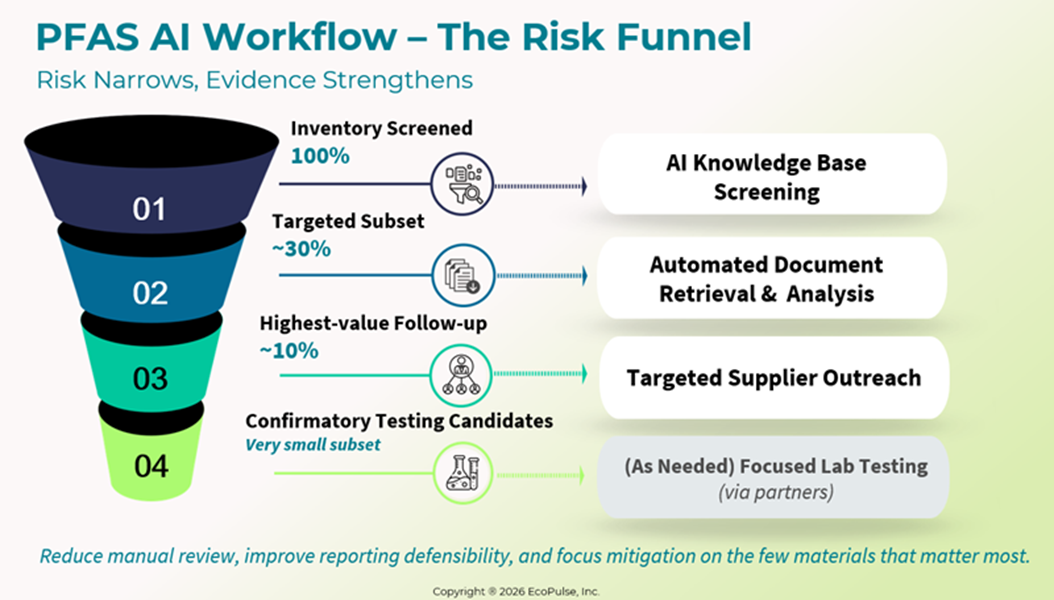
The EcoPulse PFAS AI workflow presented in the webinar follows a “risk funnel” model:
- Step 1: broad inventory screening
- Step 2: automated document retrieval and analysis
- Step 3: targeted supplier outreach
- Step 4: focused lab testing for a small subset
The goal is not just faster analysis. The goal is to:
- narrow the universe of concern
- strengthen evidence as review progresses
- improve reporting defensibility
- focus expert time on the materials that matter most
Key Takeaway 5: The future is more predictive, connected, and governed
The closing discussion pointed to what executives should expect next:
- AI will become more predictive and prescriptive
- risk intelligence will increasingly connect across functions
- governance will become even more important as adoption grows
The bigger picture is clear: PFAS is one urgent example of a much broader need. Manufacturers need better ways to connect fragmented data, prioritize action, and make more defensible risk decisions. AI will not replace expert judgment — but it can make that judgment faster, more consistent, and better informed.