PFAS Degradation Explained: From Precursors to Terminal Compounds
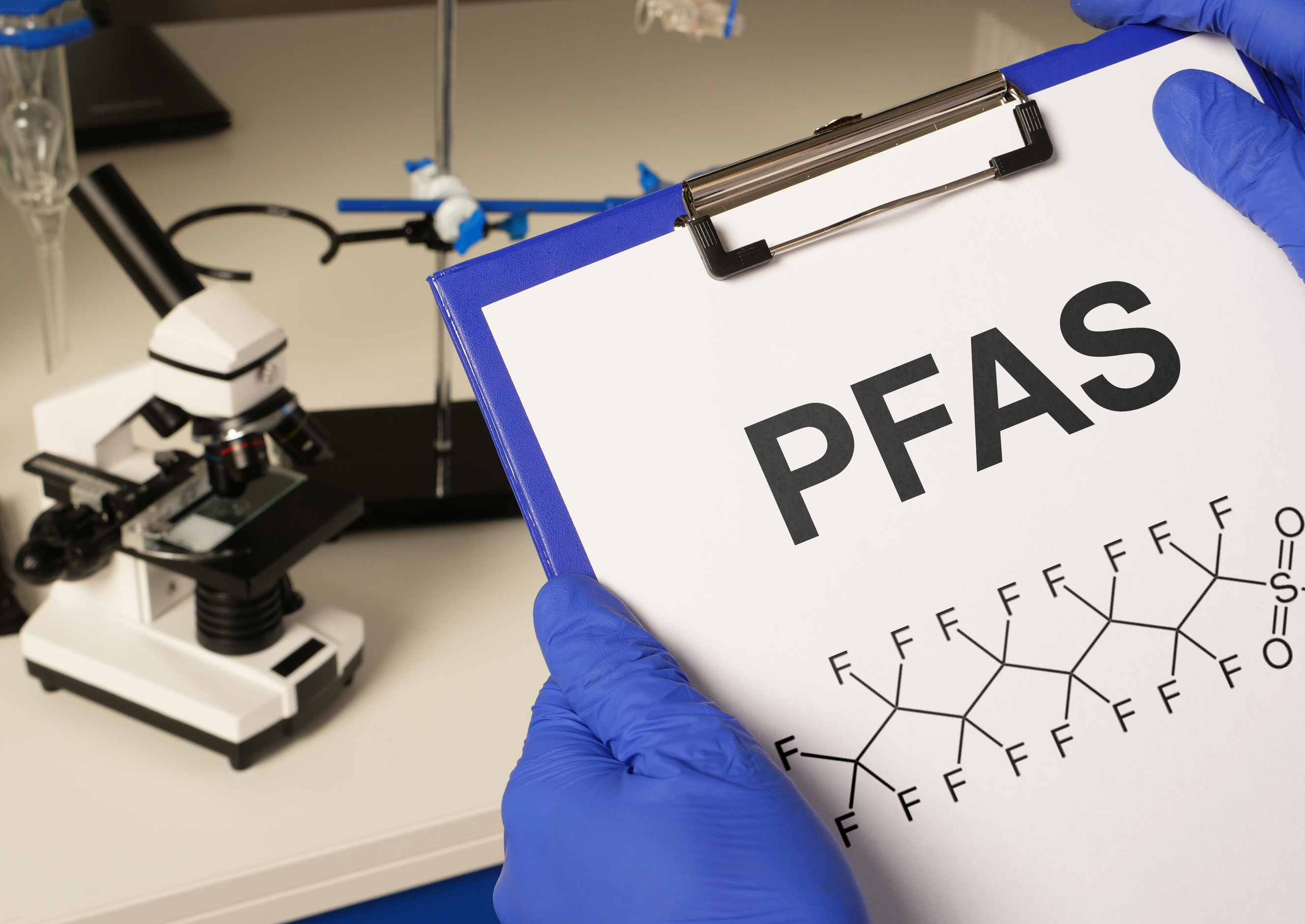
PFAS are called “forever chemicals,” yet you’ll also hear people talk about a PFAS “degrading.” Both are true. The key is knowing which PFAS, under what conditions, can degrade into what. The degradation scenarios and terminal compounds could also connect to the substitution choices manufacturers are already making.
The distinction that explains almost everything
The carbon–fluorine bond is among the strongest single bonds in organic chemistry, and it gets to be the strongest in fully fluorinated chains. The strength and stability of C–F bonds are a major reason PFAS are so resistant to degradation, but persistence also depends on molecular structure and the availability of degradation pathways. However not every PFAS is only C–F bonds. The Interstate Technology & Regulatory Council (ITRC) draws the line that matters most.
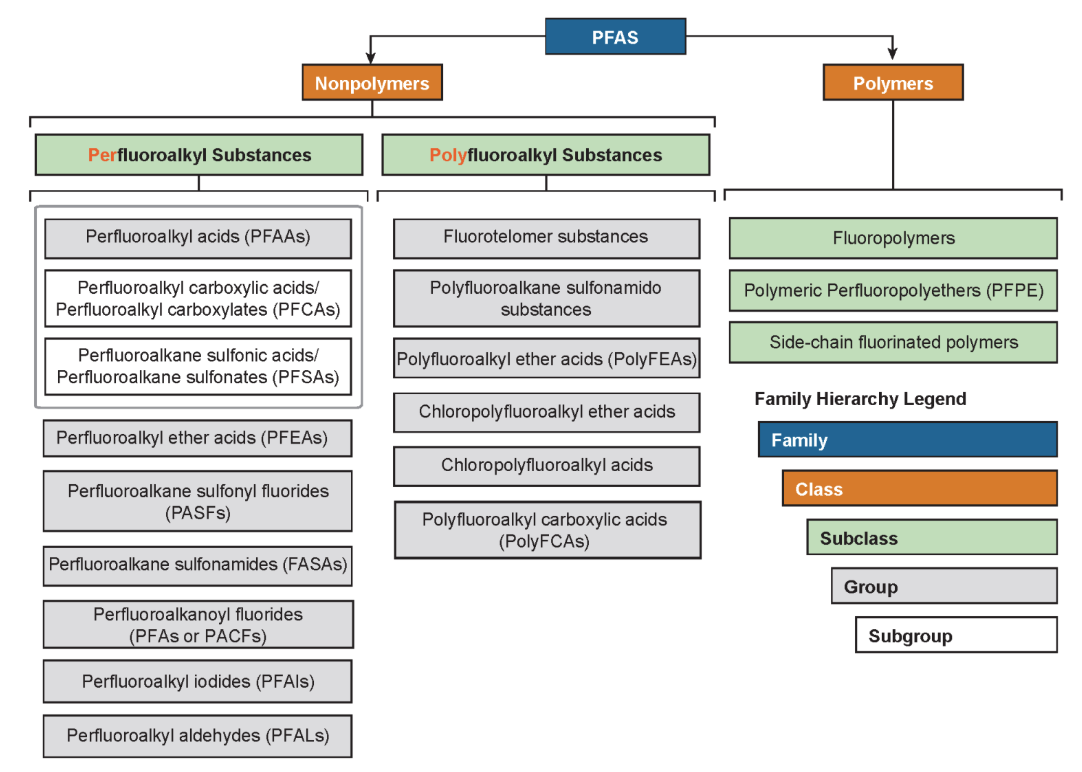
So when a PFAS “degrades,” it’s almost always a precursor transforming into a terminal acid, not a terminal molecule falling apart on its own.
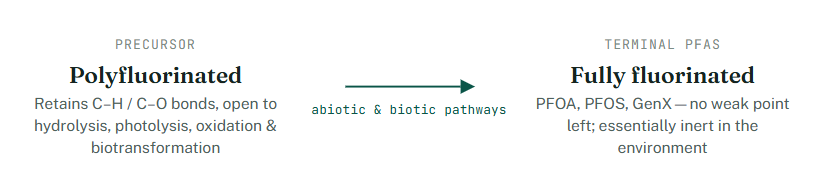
Where precursors transform, and into what
This can happen out of sight: in AFFF-impacted soil and groundwater, where precursor compounds can transform over time into persistent PFAS such as PFOS, PFHxS, and PFOA; in wastewater treatment systems, where precursor transformation can increase concentrations of some terminal PFAS while other PFAS partition into biosolids; in the atmosphere, where some fluorotelomer alcohols can oxidize into PFOA and related acids; and inside organisms, where some fluorotelomer compounds can be metabolized into terminal PFAS.
Many precursor transformation pathways involve sequential reactions and chain-shortening steps that can ultimately produce shorter-chain PFCAs. For example, 6:2 FTS has been shown to produce PFPeA and PFHxA under activated-sludge conditions, although the transformation is relatively slow and the product distribution depends on conditions.
“Long-chain degrades to short-chain” isn’t quite right. It’s precursors degrading into terminal acids, and landing shorter than where they started.
Terminal PFAS: breaks down only when forced
Terminal PFAAs generally resist biological and chemical transformation under normal environmental conditions. Engineered destruction approaches, including certain thermal, electrochemical, plasma, hydrothermal, and other treatment processes, can break down PFAS under appropriate conditions, but performance varies by technology, PFAS chemistry, matrix, and operating conditions. Demonstrating destruction requires more than showing that the parent PFAS is no longer detectable. Evidence of defluorination, transformation products, and, where practical, a fluorine mass balance can provide a more complete picture.
Can less hazardous become more hazardous?
Yes, precursor transformation is one mechanism behind PFAS regrettable substitution. A replacement can appear preferable as supplied but transform into persistent or hazardous products later in its lifecycle. Four patterns worth knowing:
Case 1:
A precursor treated as low-concern can transform through environmental or biological processes into persistent PFAS such as PFOA, PFOS, or PFHxS that are subject to significant health and regulatory scrutiny.
Case 2:
6:2 FTS still yields terminal acids now drawing regulatory scrutiny. GenX/HFPO-DA, which were developed to replace PFOA as it was phased out, drew its own EPA lifetime health advisory in 2022.
Case 3:
Some side-chain fluorinated polymers can release fluorotelomer compounds during aging or degradation. Those compounds can subsequently transform into persistent PFCAs, including PFOA for some 8:2 fluorotelomer chemistries.
Case 4:
Trifluoroacetic acid (TFA), an ultrashort-chain perfluorinated substance included within some broad PFAS definitions, is a persistent degradation product of several fluorinated refrigerants and pesticides. Its environmental presence is increasing, and in 2026 ECHA's Risk Assessment Committee recommended classifying TFA as toxic to reproduction as well as persistent and mobile.
Degradation isn’t necessarily detox. In some cases, it’s hazard redistribution.
What this suggests for company's PFAS risk management program
- Track precursor classes, not just the ~30 named terminal PFAS. A PFOA/PFOS-only screen misses the fluorotelomers waiting to transform downstream.
- Treat "short-chain" and "PFAS-free" claims as a starting point for lifecycle and substance-level scrutiny, not an endpoint.
- When vetting a destruction vendor, ask for the fluorine mass balance, not a single non-detect.
Sources
- ITRC PFAS Technical and Regulatory Guidance — Chemistry, Terminology, and Acronyms
- EPA's Fact Sheet for the 2026 Interim Guidance on the Destruction and Disposal of PFAS
- Occurrence of PFAS and their precursors in biosolids across 15 U.S. states, Environmental Science and Pollution Research
- Biotransformation pathways of fluorotelomer-based polyfluoroalkyl substances: A review, Environmental Toxicology and Chemistry
- 6:2 Fluorotelomer sulfonate aerobic biotransformation in activated sludge of waste water treatment plants, ScienceDirect
- Formation of PFOA and other perfluorocarboxylic acids during atmospheric oxidation of 8:2 fluorotelomer alcohol, PubMed
- A Review of PFAS Destruction Technologies, PMC/NIH
- International research team decodes how to safely incinerate “forever chemicals,” CSIRO
- EPA Drinking Water Health Advisories for GenX Chemicals and PFBS (June 2022)
- Fact Sheet: 2010/2015 PFOA Stewardship Program, US EPA
- TFA as a degradation product of fluorinated greenhouse gases, German Environment Agency (UBA)
- Breakdown product of pesticides and refrigerants may be classed as reproductive toxicant by EU, Chemistry World