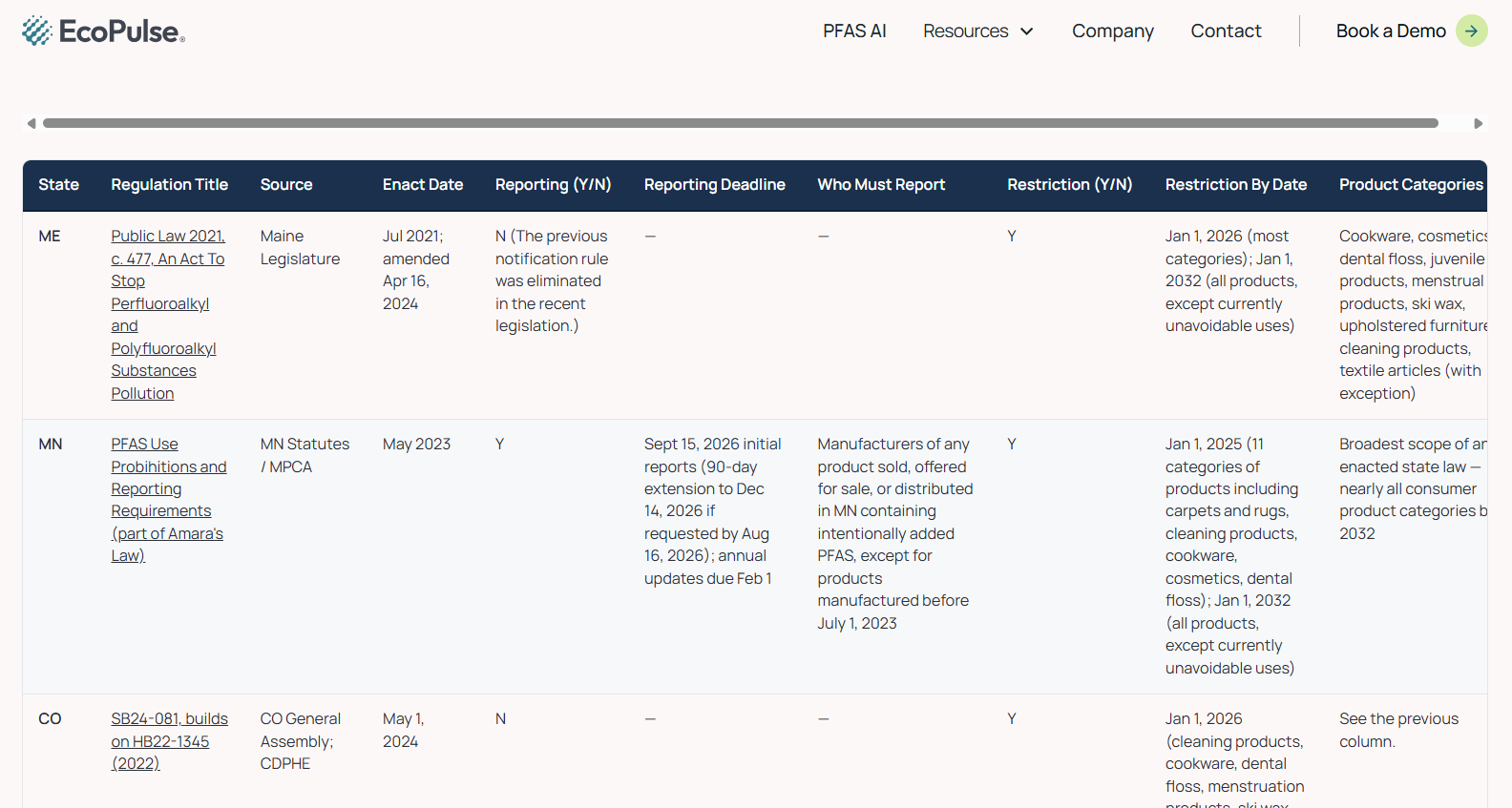
| ME |
Public Law 2021, c. 477, An Act To Stop Perfluoroalkyl and Polyfluoroalkyl Substances Pollution |
Maine Legislature |
Jul 2021; amended Apr 16, 2024 |
N (The previous notification rule was eliminated in the recent legislation.) |
— |
— |
Y |
Jan 1, 2026 (most categories); Jan 1, 2032 (all products, except currently unavoidable uses) |
Cookware, cosmetics, dental floss, juvenile products, menstrual products, ski wax, upholstered furniture, cleaning products, textile articles (with exception) |
| MN |
PFAS Use Prohibitions and Reporting Requirements (part of Amara's Law) |
MN Statutes / MPCA |
May 2023 |
Y |
Sept 15, 2026 initial reports (90-day extension to Dec 14, 2026 if requested by Aug 16, 2026); annual updates due Feb 1 |
Manufacturers of any product sold, offered for sale, or distributed in MN containing intentionally added PFAS, except for products manufactured before July 1, 2023 |
Y |
Jan 1, 2024 (firefighting foam, food packaging); Jan 1, 2025 (11 categories of products including carpets and rugs, cleaning products, cookware, cosmetics, dental floss); Jan 1, 2032 (all products, except currently unavoidable uses) |
Broadest scope of any enacted state law — nearly all consumer product categories by 2032 |
| CO |
SB24-081, builds on HB22-1345 (2022) |
CO General Assembly; CDPHE |
May 1, 2024 |
N |
— |
— |
Y |
Jan 1, 2024 (carpets/rugs, fabric treatments, food packaging, juvenile products, oil and gas products, cosmetics, indoor/outdoor textile furnishings, indoor/outdoor upholstered furniture); Jan 1, 2026 (cleaning products, cookware, dental floss, menstruation products, ski wax, textile articles, outdoor apparel for severe wet conditions, commercial food equipment, artificial turf) |
See the previous column. |
| WA |
The Safer Products Restrictions and Reporting Rule |
WA Dept. of Ecology |
Chapter 173-337 WAC was adopted in 2023. |
Y |
Jan 31, 2025, due by Jan. 31 every year |
The manufacturer of the priority consumer product, or a trade organization representing the manufacturer, may serve as the reporting party. |
Y |
Jan 1, 2025 (8 priority products and PFAS chemicals); Jan 1, 2026 (2 additional); Jan 1, 2027 (4 additional); Jan 1, 2028 (1 additional) |
Laundry detergent, drink cans, carpets and rugs, TVs and displays, fragrances and personal care products, other recreational products made from polyurethane foam, aftermarket stain and water resistance treatments, vinyl flooring, thermal paper, apparel and accessories, cleaning products, leather and textile furniture and more& |
| CT |
SB 292 / Public Act 24-59 |
CT General Assembly |
June 5, 2024 |
Y |
July 1, 2026 (manufacturer notice/reporting to CT DEEP; agency guidance still developing) |
Manufacturers of listed products manufactured, sold, or offered or distributed for sale in CT |
Y |
Jan 1, 2026 (severe-wet outdoor apparel labeling); July 1, 2026 (labeling + reporting, full list); Jan 1, 2028 (all 14 product categories) |
Apparel, turnout gear, carpets or rugs, cleaning products, cookware, cosmetic products, dental floss, fabric treatments, juvenile products, menstruation products, textile furnishings, ski wax, upholstered furniture, and outdoor apparel for severe wet conditions |
| VT |
Phaseout of Products Containing Perfluoroalkyl and Polyfluoroalkyl Substances (Act 131 and Act 54) |
VT Legislature |
Act 131 in 2024; Act 54 in 2025 |
N |
— |
— |
Y |
Jan 1, 2026 (cosmetics and menstrual products, consumer products, food packaging); Jul 1, 2027 ( cleaning products, dental floss, fluorine treated containers); Jul 1, 2028 (cookware) |
Cosmetics, menstrual products, Aftermarket stain and water-resistant treatments, artificial turf, cleaning products, cookware, dental floss, fluorine treated containers, incontinency protection products, juvenile products, residential rugs and carpets, ski wax, textiles and textile articles, food packaging |
| NM |
HB 212, “PFAS Protection Act” |
NM Environment Dept. |
Apr 8, 2025 |
Y (also has labeling requirement) |
Manufacturers must notify NM Environment Dept. by Jan 1, 2027. (Manufacturers of products containing intentionally added PFAS will be required to label products manufactured on or after January 1, 2027.) |
Manufacturers of products sold/distributed in NM with intentionally added PFAS |
Y |
Jan 1, 2027 (cookware, food packaging, dental floss, juvenile products, firefighting foam); Jan 1, 2028 (carpets or rugs, cleaning products, cosmetics, fabric treatments, feminine hygiene products, textiles, textile furnishings, ski wax and upholstered furniture); Jan 1, 2032 (all non-exempt products) |
See the previous column. |
| CA |
AB 1200 (2021); AB 1817 (2022); AB 2771 (2022) |
CA Legislative Info |
Oct 5, 2021; Sept 29, 2022 (x2) |
Y |
July 1, 2029, requires manufacturers to register with DTSC, pay a fee, and certify compliance |
Manufacturers of the covered categories (juvenile products, textile articles, food packaging) |
Y |
Jan 1, 2023 (food packaging); Jan 1, 2025 (cosmetics; textiles at 100 ppm); Jan 1, 2027 (textiles at 50 ppm); Jan 1, 2028 (severe-wet outdoor apparel) |
Food packaging, cookware (disclosure), textiles/apparel, cosmetics |
| NY |
S8817 (2020); S6291A / ECL §37-0121/S.5027-C/A.9279-A (2022); S1548/A1502 (2025) |
NY DEC / NY Senate |
Dec 2, 2020; Dec 2022; Dec 19, 2025 |
N |
— |
— |
Y |
Dec 31, 2022 (food packaging); Jan 1, 2025 (apparel); Dec 19, 2026 (menstrual products); Dec 31, 2026 (carpets); Jan 1, 2027 (apparel at DEC-set PFAS level); Jan 1, 2028 (severe-wet outdoor apparel) |
Food packaging, apparel, carpets/rugs, menstrual products |
| RI |
H7356, “Consumer PFAS Ban Act of 2024” |
RI Legislature |
June 26, 2024 |
N |
— (outdoor apparel labeling only) |
— |
Y |
Jan 1, 2025 (Class B firefighting foam, exceptions apply); Jan 1, 2027 (Carpets or rugs, cookware, cosmetics, fabric treatments, juvenile products, menstrual products, ski wax, textile articles and firefighting Personal Protective Equipment); Jan 1, 2029 (artificial turf, outdoor apparel for severe wet conditions with exemption)” |
See the previous column. |
| WI |
2019 Wisconsin Act 101 |
WI DNR |
Feb 5, 2020 |
Y |
Requires incident-triggered notification to DNR when PFAS foam is used under the emergency or testing exemptions. |
Fire departments/first responders, testing facilities |
Y (use restriction, not a sale ban) |
Sept 1, 2020 |
Class B firefighting foam — restricts fire-department use (emergency/approved-testing exceptions), not manufacture or sale |
| NJ |
Protecting Against Forever Chemicals Act (S1042/A1421); A4125/S2712, P.L.2023 c.243 (firefighting foam) |
NJ Legislature |
Jan 12, 2026 |
N |
— (Cookware requires PFAS labeling due by Jan 12, 2028) |
— |
Y |
Jan 8, 2026 (PFAS Class B foam, fire departments may use existing stock through Dec 31, 2026); ~Jan 2028 (cosmetics, food packaging, carpet, fabric treatment) |
Firefighting foam, cosmetics, food packaging, carpet, fabric treatment, cookware (labeling) |
| OR |
SB 543 (foodware); SB 546 (cosmetics); HB 3043 (children’s products); SB 91 (firefighting foam) — 2023/2025 |
OR Legislature / OHA |
May 8, 2023; Jul 31, 2023; Jul 27, 2023; 2025 |
Y |
Jan 31, 2026 (children’s products) |
Manufacturers of children’s products containing high-priority chemicals, including PFAS |
Y |
Jan 1, 2025 (foodware containers); Jan 1, 2027 (cosmetics); Jan 1, 2026 prohibition operative, with fire departments given until Jul 1, 2026 to complete PFAS foam phase-out (firefighting foam); ongoing phase-out authority (children’s products) |
Foodware containers, cosmetics, children’s/juvenile products, firefighting foam |
| IL |
HB 2516, PFAS Reduction Act amendment; HB 2409, Firefighting PPE Act |
IL General Assembly |
Aug 15, 2025 (both) |
N |
Requires IEPA to prepare and deliver a report on fluoropolymers by Aug 1, 2027 |
IEPA only |
Y |
Jan 1, 2026 (PFAS point-of-sale notice, firefighting personal protective clothing); Jan 1, 2027 (firefighting PPEs); Jan 1, 2030 (auxiliary firefighting PPE ban, other respiratory protection, hearing protection, communication devices, fall protection); Jan 1, 2032 (cosmetics, dental floss, juvenile products, menstrual products, intimate apparel) |
See the previous column. |
| HI |
HB 1644 / Act 152 |
HI Legislature |
2022 |
N |
— |
— |
Y |
Dec 31, 2024 (food packaging); Jul 1, 2024 (Class B firefighting foam training/testing use) |
Food packaging (wraps, plates, boats, pizza boxes); firefighting foam (training/testing use) |
| MD |
HB0643 (2021); SB273/HB275, “George ‘Walter’ Taylor Act” (2022) |
MD General Assembly |
May 2021; Apr 21, 2022 |
N |
— |
— |
Y |
Jan 1, 2024 (food packaging, rugs/carpets, firefighting foam); Jan 1, 2025 (cosmetics) |
Cosmetics, food packaging, rugs/carpets, firefighting foam |
| NH |
HB 1649 |
NH Legislature (LegiScan) |
Aug 2, 2024 |
N |
— |
— |
Y |
Jan 1, 2027 |
Children’s products, furniture, carpets/rugs, cosmetics, feminine hygiene products, fabric treatments, food packaging/containers, PFAS-treated waxes, textile furnishings (secondhand & ≥85% recycled-content exempt) |
| MA |
S.2902 |
Mass.gov |
Aug 15, 2024 |
Y |
Ongoing from Jan 2025 (point-of-sale notice to purchaser, not a state filing) |
Manufacturers/sellers of firefighter PPE sold in MA |
Y |
Jan 1, 2027 |
Firefighter PPE (jackets, pants, footwear, gloves, helmets, respiratory equipment) |